Learn backgammon
In brief
- The app's 13-step tutorial shows each rule on the actual board.
- The playing tips below are guidelines: the right move always depends on the position.
- A lone checker 6 points away from an opposing checker is hit by 17 out of 36 rolls (47%); beyond 6 points, the risk drops.
Getting started with the app
- New game: choose the computer's level, Easy, Medium (default) or Hard, and whether the doubling cube is used.
- Roll the dice: tap the screen. Then move your checkers, one die at a time.
- Move assist: on by default, this option highlights the points where a checker can go. You can change it in the settings.
- Pip count: both counts stay displayed at the bottom of the screen; tap them for an explanation.
- Tutorial: 13 interactive steps, from the starting setup to bearing off.
- Settings: light or dark interface, or set to follow the system; two boards, "Wood, orange and green" and "Dark walnut, burgundy"; 36 languages; statistics by level.
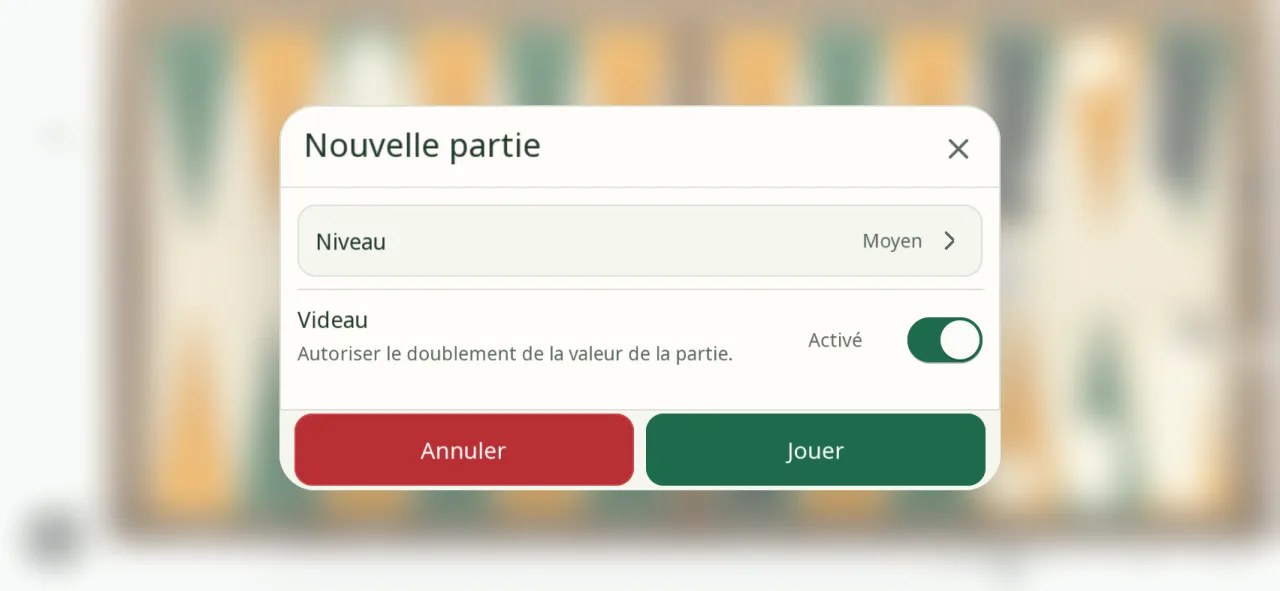
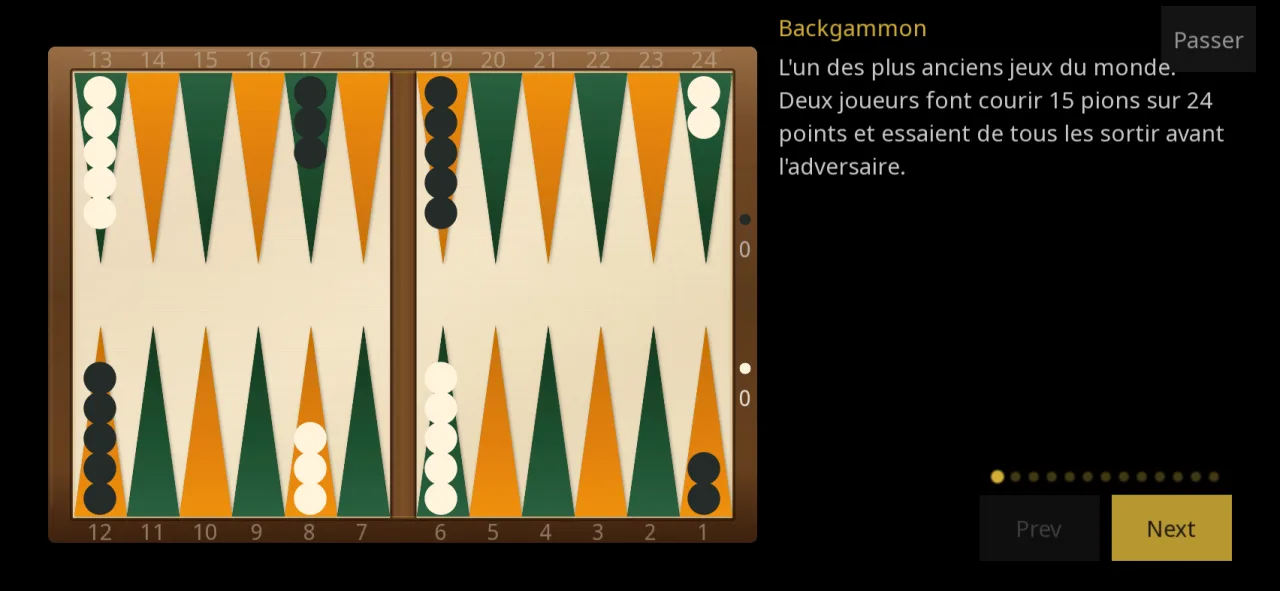
The levels: Easy plays a random legal move; Medium follows a simple scoring scheme (hitting, bearing off, entering, making a point, avoiding lone checkers); Hard compares every way of playing the roll and evaluates the resulting position.
Playing guidelines
These guidelines help you choose between several legal moves. None of them is a rule: each can give way to the position.
Making points Depends on the position
A point you close hinders your opponent, especially in your home board: a checker that is hit will have a harder time entering (see the table below). Several closed points in a row form a prime that is hard to get past.
Lone checkers and risks Depends on the position
A lone checker can be hit and sent back to the bar, at the very start of its journey. The risk can be measured: at 6 points away, 17 out of 36 (47%) rolls hit it; at more than 6 points away, never more than 6 out of 36 (17%). Leaving a lone checker far from the opponent, or where being hit would matter little, is often an acceptable risk.
The race and the pip count Depends on the position
When no checker can pass another one anymore, the game becomes a race: only the number of points left to travel matters. The pip count shown by the app tells you who is ahead. Before that point, a lead in pips often favors going for the race, while a deficit favors keeping contact.
When to offer the cube Depends on the position
You offer the cube when you think you have gained the advantage, without waiting to be too far ahead: your opponent would then decline and lose only the current value. No threshold fits every position. In the app, the computer decides based on the difference in pip counts.
Chances of hitting a lone checker
Rolls that let one of your checkers land on a lone opposing checker, depending on the distance, playing one die or both (direct or indirect shot), with no closed point in between. Counted over the 36 possible rolls of two dice.
| Distance | Rolls that hit |
|---|---|
| 1 pip | 11 out of 36 (31%) |
| 2 pips | 12 out of 36 (33%) |
| 3 pips | 14 out of 36 (39%) |
| 4 pips | 15 out of 36 (42%) |
| 5 pips | 15 out of 36 (42%) |
| 6 points away | 17 out of 36 (47%) |
| 7 points away | 6 out of 36 (17%) |
| 8 points away | 6 out of 36 (17%) |
| 9 points away | 5 out of 36 (14%) |
| 10 points away | 3 out of 36 (8%) |
| 11 points away | 2 out of 36 (6%) |
| 12 points away | 3 out of 36 (8%) |
Chances of entering from the bar
Rolls that let you enter a checker from the bar, depending on how many points your opponent has closed in their home board.
| Closed points | Rolls that enter |
|---|---|
| 1 | 35 out of 36 (97%) |
| 2 | 32 out of 36 (89%) |
| 3 | 27 out of 36 (75%) |
| 4 | 20 out of 36 (56%) |
| 5 | 11 out of 36 (31%) |
| 6 | 0 out of 36 (0%) |